
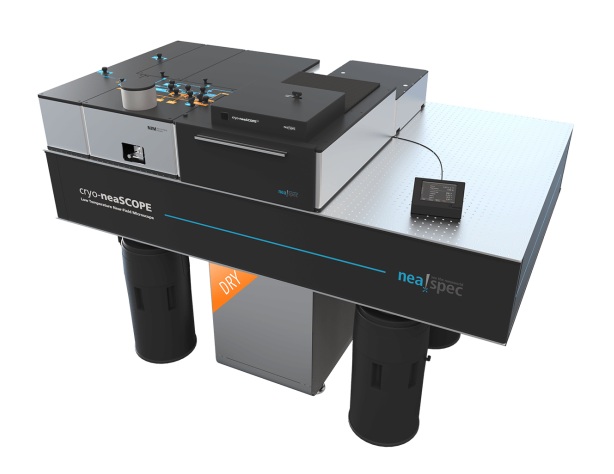
Cryogenic optical nanoscopy
Posted On: 17 Dec 2025
A new lens for viewing quantum materials
Temperature is one of nature’s tuning knobs for manipulating material properties: sample cooling to cryogenic conditions suppresses thermal noise, stabilizes quantum phases, and sharpens spectral features, granting unprecedented control over material behavior. Combining cooling with nanoscale-resolved optical imaging can uncover new material properties invisible at room temperature as highlighted in the application examples below:
Nanoscale variations of exciton energies
Roche et al. used a cryo-neaSCOPE+xs equipped with a tunable VIS/NIR laser to perform cryogenic s-SNOM exciton spectroscopy at 11 K on a MoSe2 monolayer encapsulated in hBN. Sum-1 meV energy resolution of neaSCOPE allowed for an accurate measure of the exiton energy and linewidth (that changes from 30 meV at room-T to 4 meV at 11 K). High spatial resolution resolved subtle variations in the exciton resonance, revealing nanoscale disorder invisible at room temperatures. Amplitude- and phase-resolved measurements delivered by cryo-neaSCOPE further enable an extraction of the sample dielectric function for full quantitative analysis. These findings offer valuable details about 2D material heterogeneity and establish cryogenic visible s-SNOM as an effective nanoscale excitonic probe.
Further reading:
A. S. Roche et al., Nano Letters 25, 32, 12166-12172 (2025)

Nano-island formation during metal-to-insulator phase transitions

Tiwari et al. used IR and THz s-SNOM to study the metal–insulator transition of magnetite (Fe3O4), a strongly correlated ferrimagnetic material, at ∼113 K with nanoscale spatial resolution. Sub-Kelvin resolved nanoscale imaging revealed the formation of defect-stabilized metallic nano-islands forming during the transition, reproducible across cooling cycles. Combined IR and THz data confirm a first-order metal-to-insulator transition, demonstrating that IR cryo-neaSCOPE+xs is an effective tool for probing electronic properties of strongly correlated materials.
Further reading:
K. Tiwari et al., Adv. Func. Mat. e07075 (2025)
Topological transitions in polariton dispersions
Liu et al. used the cryo-neaSCOPE+xs nano-FTIR capability to uncover an emergence of hyperbolic surface phonon polaritons (hSPhPs) in a YVO4 crystal in the non-hyperbolic spectral range (∼890–905 cm-1). They mapped hyperbolic wavefronts in real space and demonstrated for the first time a temperature-controlled topological transition from hyperbolic disperion to canalization and to the eliptic regime. Precise, vibration-stable temperature control of cryo-neaSNOM enabled reproducible tuning of polariton topology, wavelength and propagation characteristics. This could help extending the realm of hyperbolic nano-optics and bringing new opportunities into such applications as negative refraction, superlensing, sensing and integrated photonics.
Further reading:
L. Liu et al. Nature 644, 76 (2025)

The cryo-neaSCOPE+xs sets a new benchmark in nondestructive nanoscale analytics — delivering 20 nm spatial resolution across an unmatched spectral range from visible to mid-IR and terahertz, while operating from <10 K to 300 K. These capabilities were pivotal in the showcased research and provide a powerful foundation for uncovering new material properties and phenomena in the future.